


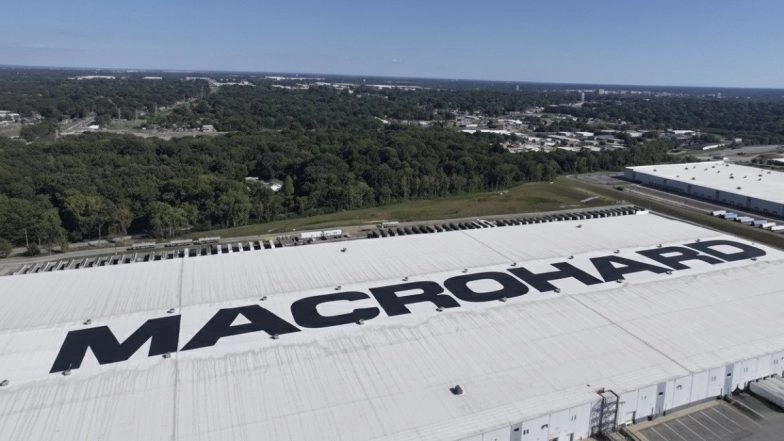
Elon Musk has shared details of a new artificial intelligence concept called Macrohard, an initiative he says could eventually perform many tasks currently handled by human workers.
The project is expected to involve collaboration between xAI and Tesla. The concept focuses on combining advanced artificial intelligence with robotics to create systems capable of carrying out complex operational functions.
According to the description shared by Musk, Macrohard would function as a large integrated platform where an AI model serves as the decision-making engine while physical tasks are handled by robotic systems.
The AI component would rely on Grok, which is designed to analyse data, interpret instructions and coordinate tasks. Physical operations would be performed by Tesla Optimus, a humanoid robot intended for use in real-world environments such as factories, warehouses and other operational settings.
Together, these technologies are envisioned to create a system capable of executing a wide range of organisational tasks. These could include data analysis, customer service management, logistics coordination and other digital workflows that are commonly handled by office-based employees.
To support such capabilities, the project would rely on significant computing infrastructure. The system is expected to integrate Tesla’s internal hardware with high-performance chips produced by companies such as Nvidia, whose processors are widely used for artificial intelligence development.
The concept reflects a broader shift across the global technology sector toward more advanced AI-driven automation systems.
Tesla’s Optimus robot also plays a central role in Musk’s longer-term vision for robotics. The robot was initially introduced as a machine designed to perform repetitive or potentially hazardous tasks in industrial environments. Musk has previously suggested that such robots could eventually be manufactured at large scale and deployed across multiple industries.
The idea has also renewed debate about the potential impact of artificial intelligence on employment. Analysts note that while automation has historically affected manufacturing roles, newer AI technologies are increasingly capable of assisting with white-collar work such as research, writing, customer support and software development.
Industry observers say developments in AI and robotics could reshape workplace structures in the coming years, although the scale and timeline of such changes remain uncertain.

 Get it on Play Store